Navigating Crisis in Sierra Nevada and Central California Forests
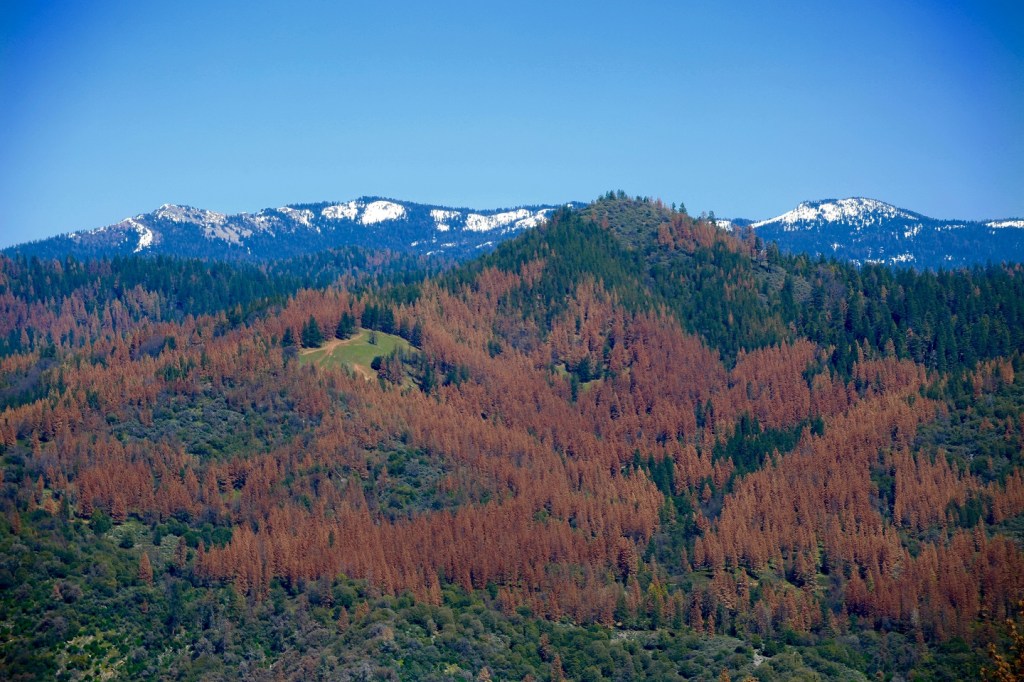
The Sierra Nevada and sprawling woodlands of Central California have long stood as symbols of endurance, defined by ancient giants and vast, emerald canopies. However, as we move through 2026, these landscapes are undergoing a profound and visible transformation. What was once a slow environmental shift has accelerated into a complex struggle for survival, leaving our forests at a critical crossroads.
A Landscape in Transition
For those walking trails within central Sierra today, the scenery has changed. The vibrant greens of the past are increasingly punctuated by “red-needle” silhouettes—a calling card of trees that finally succumbed to a decade of environmental pressure.
Although heavy snow packs of recent Winters provided a much-needed drink for thirsty roots, recovery is not as simple as adding water. Our forests are currently dealing with a “biological hangover” from years of extreme heat. Since 2010, the U.S. Forest Service recorded a staggering 200 million dead trees across the state . While the fever broke slightly in 2024 and 2025, with annual mortality dropping to a decade-low of roughly 6.6 million trees, the baseline of death remains significantly higher than historical norms. As of mid-January forest service nursery reached its annual limit for reforestation tree requests.
The Invisible War Under the Bark
The primary architect of this change isn’t just the heat, but the tiny creatures that thrive in it. Native bark beetles—specifically the fir engraver beetle—have become the dominant force in the central Sierra. In a healthy year, a tree can “pitch out” these invaders with sticky resin. But years of moisture stress have left these giants defenseless.
In recent surveys, the fir engraver beetle alone was responsible for nearly 75% of tree deaths in the region. This is no longer a natural thinning of the woods; it is an epidemic that is reshaping which species will dominate our mountains in the decades to come.
The Density Dilemma
We are also witnessing the consequences of a century of well-intentioned but lopsided forest management. By aggressively suppressing every small fire for over 100 years, we have allowed our forests to become overgrown. In many parts of Central California, forests are now two to five times denser than they were historically.
This overcrowding creates a “too many straws in the cup” scenario. When a drought hits, there simply isn’t enough water to go around, leaving every tree in the stand vulnerable. This density also creates a dangerous ladder for wildfires, allowing flames to jump from the forest floor to the crowns of the tallest trees with terrifying speed.
A Call to Resilience
Despite these challenges, there is a path forward. The current crisis has sparked an unprecedented era of cooperation between scientists, state agencies, and the public. We are learning that to save the forest, we must sometimes thin it—returning it to a more open, resilient state that can withstand the “hotter droughts” of the future.
For those who love California’s wild places, staying informed is the first step toward advocacy. You can explore the California Tree Mortality Viewer to see how your local area is faring, or visit CAL FIRE to learn how to create defensible space around your own property.
This story of the Sierra Nevada is not over; it is simply entering a new, more fragile chapter. By understanding these stats and stressors, we can better support all management efforts required to keep these natural Guardians of Nature standing for future generations.
 Guardians Around The Earth